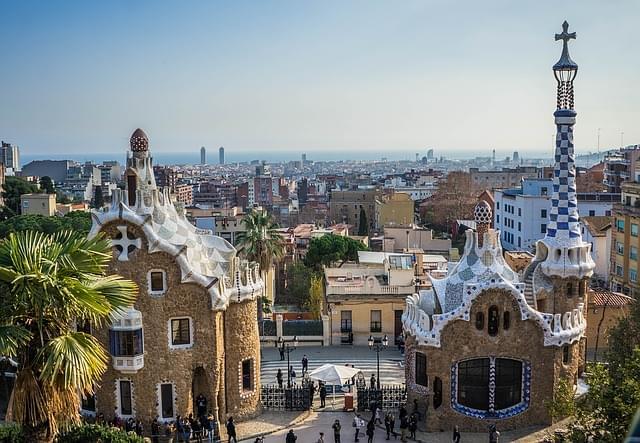
 The idea behind Parc Güell was to create a small garden city, containing a total of 40 houses, fully integrated with the surrounding nature. The project failed, however, and in the end only two houses were built, and the fairy-tale structures that are now world-famous were built. The park is divided into two areas, one for free access and the other for a fee, both of which bear great witness to Gaudi's passage. Here is some useful information on how to get to and visit Barcelona's most famous park and one of the city's main attractions.
Where it is located and how to get there
Onfoot: Parc Güell is far from the centre and is located on top of a hill, so it is difficult to get there without public transport, unless you are staying in the Gracia district.
By bus: lines H6, 32, 24 and 92. Lines H6 and 32 arrive at a stop located on Travessera de Dalt, from here it takes 10 minutes on foot to reach the entrances on Carrer Sant Josep de la Muntanya or to the entrance on Carrer de Larrard, both of which have escalators. Lines 24 and 92 stop near the park's main entrance. The Bus Turístic, a blue line, has the stop'Park Güell' while, for the Barcelona City Tour, the route is 'East', green in colour, but the stop is the same. From here it takes another 10 minutes to reach the park, and the recommended entrance is on Carrer de Larrard.
By metro: take the green line L3 and get off at two stops. The first is Vallcarca, which is 13 minutes from the park, and you can use the escalator at Baixada de la Gloria, and then go towards the entrance at Passatge de Sant Josep de la Muntanya. The other stop is Lesseps, which is 15 minutes away from the park, and again the same entrance is recommended.
SEE ALSO: Getting around Barcelona
Entrance Hours
From 1 January to 16 February 2018: from 8.30 am to 6.30 pm (last entrance to the monumental part is at 5.30 pm)
From17 February to 25 March 2018: from 8.30 a.m. to 7 p.m. (last admission to the monumental part is at 6 p.m.)
From26 March to 29 April 2018: from 8 a.m. to 8.30 p.m. (last entrance to the monumental part is at 7.30 p.m.)
From30 April to 26 August 2018: from 8 a.m. to 9.30 p.m. (last entrance to the monumental part is at 8.30 p.m.)
From27 August to 27 October 2018: from 8 a.m. to 8.30 p.m. (last entrance to the monumental part is at 7.30 p.m.)
From28 October 2018 to 31 December 2018: from 8.30 a.m. to 6.30 p.m. (last entrance to the monumental part is at 5.30 p.m.)
After the times indicated above, admission to the Monumental Zone is free, as evening begins to fall and little can be seen. In summer, however, when the day is longer, visiting this part of the park in the evening can be a good way to save on the entrance fee.
Ticket cost:
Admission to the park is free while the Monumental Zone is chargeable. If you buy your ticket online, which is useful to avoid queues, you will need to indicate the day and time of your visit when booking.
IMPORTANT: You can stay inside the Monumental Zone for as long as you wish, but once you leave, you will not be able to re-enter, unless you buy a second ticket
Adult rate: €8.50 for the Monumental Zone, €5.50 for the Gaudí House.
Reduced rate: €6.00 (children from 7 to 12 years old, over 65, accompanying person of a disabled person) for the monumental zone. €4.50 (under 30 years old and pensioners) for the Gaudí House.
Free admission: Children from 0 to 6 years old do not pay admission to the Monumental Zone. Children under 11 do not pay for entry to the Casa Gaudi Museum.
Tours, guided tours and online tickets
What to see and how to visit the Parc Güell
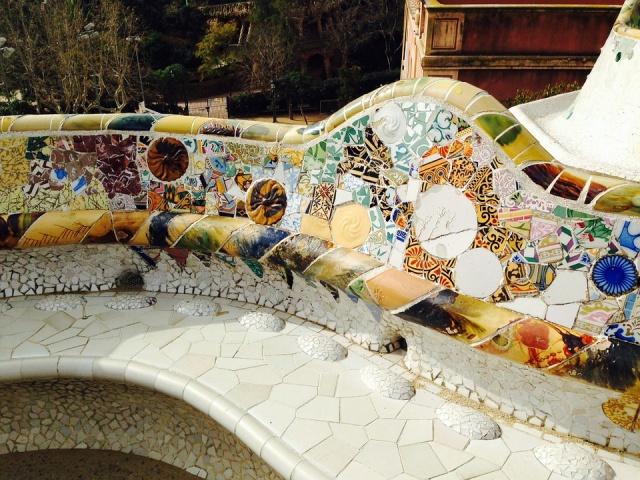 The Parc Güell is divided into the Monumental Zone, which contains all the most famous attractions, and the Free Zone, which consists of a beautiful park. To enter the Monumental Zone you need an entrance ticket (more information in the paragraph above) and it is recommended to visit it first to avoid queues.
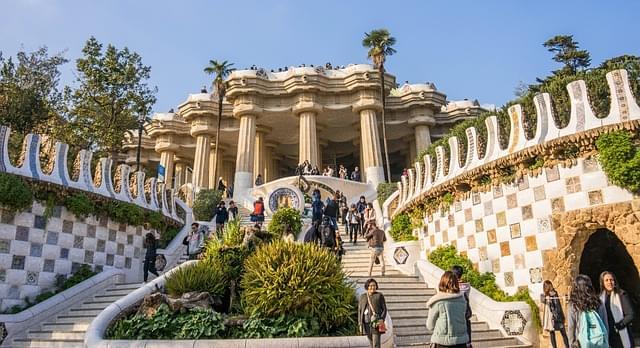
Inside this zone you will be able to admire the famous Lizard Staircase, surrounded by two cave-like terraces that once served as stables. As you walk down the staircase you will encounter statues of Goblins, symbols of Catalonia, and the famous mosaic lizard, which is actually a salamander, the symbol of the park itself. Arriving at the top of the staircase, you will come across the Doric Temple, formed by 88 twisted columns that seem to start directly from the roots of trees. This particular construction was designed to serve as a market place. As you continue walking, you can admire the Banc de Trencadis, another symbol of the park, which runs along the perimeter of the Plaça de la Natura, a large terrace covered in ceramic mosaics from which you can enjoy one of the best views of the city. The Banc is nothing more than a very long bench covered in ceramics, designed by architect Josep Maria Jijol.
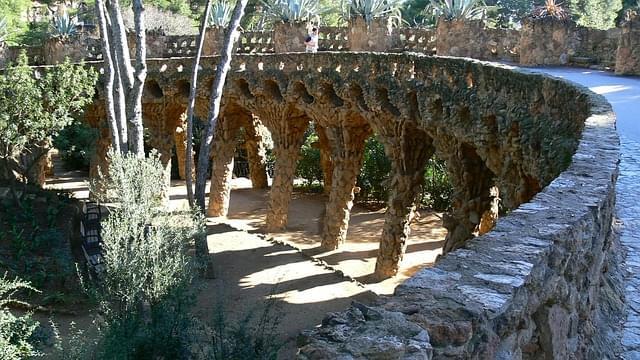 The peculiarities of the park's Free Zone, on the other hand, are clearly visible as soon as visitors arrive at the southern entrance. What characterises Carrer d'Olot are the rustic surrounding walls, on which one can see the various ceramic medallions with Parc Güell written on them. The main entrance is then characterised by two strange mosaic houses, in the style of Hansel and Gretel's fairy tale, designed to be the park's caretaker's rooms: they have a waiting room including a telephone. This is the largest part of the park, representing 91% of it, and is full of paths and climbs, so comfortable shoes are recommended.
In this area you will find structures, monuments and colonnades, chosen as shelters from the sun by street musicians, and some of the park's original houses, including Gaudí's famous Casa Museo, where the architect lived between 1906 and 1926. The House was turned into a museum in 1963, and can be visited by paying the entrance fee mentioned above.
Useful tips for visiting the attraction
Get up early: it is best to visit the park early in the morning, when the light for photos is better, and you will have a chance to photograph the mosaic lizard without someone sitting on it.
Buy thecity card: the Barcelona Pass includes a ticket to the monumental part of the park, with a skip-the-line option.
Ticket: It is recommended that you buy your ticket to the monumental area on the Internet. In this case you will be asked to indicate the date of your visit, and the time: there is a 30-minute tolerance on the time indicated on the ticket. For example, if you have bought your ticket for nine o'clock, you can enter until nine thirty, no later. If you already have a ticket, prefer the west entrance, where there are usually fewer people. If you are entitled to reductions, try to bring your documents to prove it (identity card, student card, etc.) otherwise you will not get them.
Wear comfortable shoes: the park is uphill and there are several stairs.
Bring a sack lunch: the prices in and around the park are quite high.
History, trivia and practical information: what to know in brief
 The park is named after Eusebi Güell, a wealthy Catalan businessman and friend of Antoni Gaudí, from whom he had the Güell palace, the Güell cellars, the Güell pavilions and even a crypt designed. After his visit to the United Kingdom, Güell was particularly impressed by the 'garden cities', an urban core combining country life with urban comfort.
Wishing to replicate the experience on Catalan soil, Güell commissioned Gaudí to build a garden suburb using a bare slope behind Barcelona, the Muntanya Pelada, where he owned an old farmhouse. Work began in November 1900 and included sixty triangular-shaped areas preparatory to the building of housing, each with appropriate green areas. The project, however, was a commercial disaster: no one showed any interest in the venture. Of the sixty houses initially planned, only three were built: in one of them the architect lived with his elderly father and granddaughter, before moving to the Sagrada Família building site.
Where to stay:
If you're planning a visit to Parc Güell and want to stay near the park, there are several accommodation options available. One such option is the Ayre Hotel Rosellón, located just a 20-minute walk from the park. The hotel offers modern and comfortable rooms with a range of amenities, including free Wi-Fi, air conditioning, and a flat-screen TV. In addition to its convenient location, the hotel also boasts a rooftop terrace with panoramic views of the city. Whether you're looking for a luxurious stay or a budget-friendly option, there are plenty of accommodations to choose from in the Gracia district. However, if you want to stay near the park and enjoy easy access to Parc Güell's stunning views and fairy-tale structures, the Ayre Hotel Rosellón is an excellent choice.
Haven't booked your flight and hotel yet? Check out our offers!
Cheap flights: from €29.00 - look at the offers
Where to stay: Hotels and B&Bs from €40.00 per room - see offers